
How is SROI Different From Other Types of Evaluations?

Updated: Aug 12
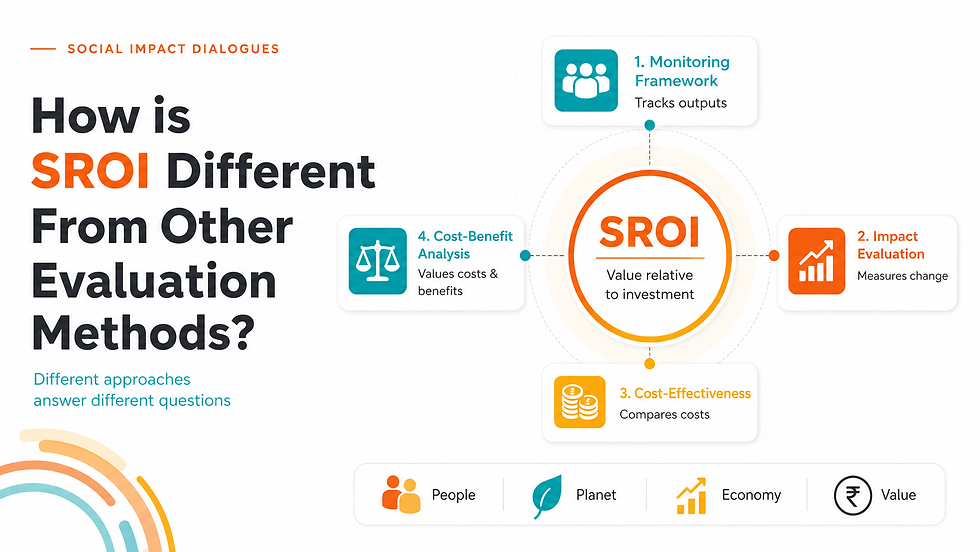
During our recent Social Impact Dialogue on Social Return on Investment (SROI) on 29th July 2026, over 250 practitioners from NGOs, CSR foundations, philanthropy, consulting firms and academia joined us to learn about two use cases of the methodology. While we managed to cover the fundamentals of SROI during the session, the questions that came in afterwards revealed something interesting: most people were trying to understand where SROI fits within the broader landscape of monitoring, evaluation and impact assessment.
Questions such as "How is SROI different from a normal impact assessment?", "When should I use SROI instead of Cost-Benefit Analysis?", "Does SROI replace my Monitoring & Evaluation framework?", and "Should every CSR project conduct an SROI?" surfaced among participants.
Different Approaches Answer Different Questions
Monitoring systems tell us whether activities are being delivered. Impact evaluations tell us whether programmes are producing meaningful outcomes. Process evaluations help us understand whether resources are being used efficiently. SROI brings these perspectives together by asking whether the value created for stakeholders outweighs the resources invested.
Rather than viewing these approaches as competing with one another, it is more useful to think of them as complementary tools—each designed for a different purpose.
Approach | The primary question it answers | Typical outputs | Best used when... | Example |
Are we delivering the programme as planned? | Activities completed, outputs achieved, implementation progress, dashboards | You need to track implementation, improve programme management, or report regularly to donors and management. | Tracking conservation targets, habitat recovery, and species populations in restoration projects | |
Impact Evaluation / Social Impact Assessment | Did the programme create meaningful change, and what changed for different stakeholders? | Outcomes, impact pathways, evidence of intended and unintended changes, lessons learned | You want to understand whether the intervention worked, for whom, and why. | Community impacts of urban development on housing and social equity |
Cost-Effectiveness / Cost-Efficiency Analysis | What did it cost to achieve each output or outcome? | Cost per beneficiary, cost per child reached, cost per job created, cost per learning gain, etc. | You need to compare delivery efficiency across programmes or implementation models. | Cost per life saved through public health interventions |
Cost-Benefit Analysis (CBA) | Do the overall economic benefits outweigh the costs to society? | Net Present Value (NPV), Benefit-Cost Ratio (BCR), Internal Rate of Return (IRR) | Governments and economists need to compare investments such as infrastructure, public policy or large-scale programmes. | Hydroelectric power benefits vs river ecosystem disruption and community displacement |
How much social, environmental and economic value was created for stakeholders relative to the investment made? | Social value created, SROI ratio, stakeholder insights, valuation of outcomes, recommendations for improving programme design | You want to understand the broader value created for people and communities—not just whether the programme worked, but what that change is worth from a stakeholder perspective. | Educational and lifetime earning benefits per rupee invested in early childhood education |
What Makes SROI Different?
The biggest difference is that SROI is fundamentally stakeholder-centred. Traditional evaluations often ask:
Did incomes increase?
Did school attendance improve?
Were beneficiaries satisfied?
Were project targets achieved?
SROI asks all of these questions too—but it then goes one step further. It asks:
Which of these changes actually mattered most to stakeholders?
How valuable were these changes in people's lives?
What would these outcomes be worth if we expressed them in monetary terms?
Did the programme create sufficient value to justify the investment?
This is why SROI involves much more than simply attaching a financial number to outcomes. It requires understanding which changes are material to stakeholders, identifying credible financial proxies for those changes, accounting for factors such as deadweight and attribution, and being transparent about the assumptions made along the way.
You May Also Read: Practical Considerations When Conducting an SROI
Which Approach Should You Choose?
The answer depends entirely on the decision you are trying to make. If your priority is understanding whether implementation is on track—a strong monitoring framework is sufficient. If you want to understand whether people's lives have changed because of your programme—an impact evaluation or social impact assessment is the appropriate choice. If your objective is to compare delivery efficiency across programmes—cost-effectiveness analysis may provide the most useful insights.
However, if you want to answer a broader question—whether the programme created sufficient social value to justify the investment, and how different stakeholders experienced that value—then SROI becomes a powerful addition to your evaluation toolkit.
Importantly, these approaches are not mutually exclusive. The strongest organisations often use all of them at different stages of a programme's lifecycle, with each contributing a different piece of the evidence puzzle.
Watch the full webinar here: https://swiy.co/WebinarSROI.
If you're looking to build your first SROI, the following open-access resources are the best place to start.
Resource | What it includes |
The definitive step-by-step guide to conducting an SROI, from stakeholder engagement and Theory of Change to valuation, discounting and reporting. | |
The standard template is used to map stakeholders, outcomes, indicators, financial proxies and impact adjustments across any SROI study. | |
Detailed guidance on applying the Principles of Social Value, including materiality, stakeholder engagement, valuation and assurance. | |
Case studies, technical papers and practical examples across different sectors. | |
A searchable database of indicators, outcomes and financial proxies that can support valuation, while always requiring contextual adaptation. |


