
Process Documentation - The How and Why ! (With Toolbox & Casestudy)
- The 4th Wheel

- May 1, 2018
- 3 min read
Updated: Sep 16, 2025
Documentation is often seen as a difficult task by most development organisations. The documentation challenge generally links back to a lack of knowledge on and usage of ideal tools and techniques for documentation. Another critical challenge is from the point of view of motivation for and realisation of the need for documentation.
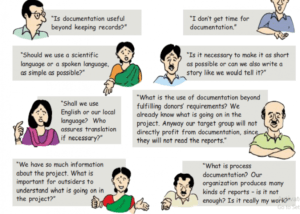
Photo source: Process Documentation-A Practical Manual for Development Workers, Action for Food Production (AFPRO)
This article explores the necessity and importance of documentation – not only at the end of a programme to highlight results, but also regular documentation of processes followed and experiences in achieving results.
Process documentation: An overview of the concept
Process documentation is not about selling a success story, but about monitoring a process of change and development. To put it in the simplest way possible, it is more about the ‘how’ of the implementation process than about the ‘what’ of process impact.
The primary aim of process documentation is to LEARN and IMPROVISE. It specifically aims at
Capturing the perceptions of stakeholders and changes in these perceptions
Using this information to support reflection and learning to improve the process
Helping those looking at the process from outside to understand the changes in knowledge, attitudes, and behaviours that were necessary to achieve results
Keep in mind… A process documentation has to reflect the change process through the eyes of all stakeholders involved – programme funders, programme leads and managers, on-field implementation team, programme beneficiaries and their families, relevant community institutions and leaders etc. |
Why is it important?
Process documentation can facilitate self-reflection and learning. This is how…
It throws light on a programme’s path of development.
While result-oriented reports do show the performance of a programme, they do not accommodate for how activities were successfully undertaken, the processes of how and why certain activities were not so successful, or simply not possible. Process documentation records and supports the process of change, thus making programme learning, improvisation, and replication easier.
It indicates the extent of empowerment and participation of ‘people’ (local communities).
Development projects are about people and people cannot be reduced merely to results. Process documentation ensures that the extent to which local communities were involved in and contribute to the change process is reflected and documented.
It gives importance to and documents experiential learning.
Every project is a life process. Process documentation takes into account detours, unforeseen twists and turns, and learning loops that serve as critical learning points for programme stakeholders as well as external stakeholders implementing or planning to implement programmes in similar domains or geographies.
Keep in mind… -Process documentation should focus on both programme success and gaps. An integration of both are key for programme learning and improvisation -Result orientation and process orientation are mutually interdependent for effective documentation of change |
The benefits and challenges in application
Benefits internal to the organisation…
Gaining systematic knowledge about their project
Bringing forth the hidden and sometimes unconscious knowledge about the processes in the project to help in further strategising and planning
Publicity for the Non-Governmental Organisation (NGO) as a learning organisation
Benefits external to the organisation…
Best in practice examples for other organisations and stakeholders in conceptualising, planning, and strategising programmes in similar domains/geographies
Available resource for understanding local contexts and resources
A platform for knowledge sharing and exchange
Potential challenges…
Stakeholders behave significantly differently when they know what they say is being used for process documentation, thus the outcomes may be biased
Those responsible for process documentation may not understand the process they are documenting and analysing
Effort and resources put into process documentation might slow the programme or reduces its economic viability


Comments