Theory of Change vs Logical Framework: Key Differences Every CSR Project Should Understand


Every CSR project begins with a simple question: What change are we trying to create? Answering that question, however, is never that simple. Organisations must understand the problem, identify the pathway to change, define success, and establish a system for measuring progress. Without that clarity, even well-funded initiatives can struggle to deliver meaningful outcomes.
Two planning tools are widely used to bring structure to this process: the Theory of Change and the Logical Framework. Although they are often mentioned together, they serve different purposes and are designed to answer different questions. Confusion around theory of change vs logical framework can lead organisations to choose a tool that does not match their program needs or stage of planning.
Understanding the difference between theory of change and logical framework helps CSR teams design stronger programs, define realistic outcomes, improve impact monitoring systems, and make better implementation decisions. This guide explains how each framework works, where each one adds value, and how organisations can use them together to build more effective CSR projects.
Key Takeaways
A Theory of Change explains how and why change is expected to happen.
A Logical Framework organises implementation, monitoring, and reporting.
Both frameworks serve different purposes and work best when used together.
Choosing the right tool depends on the project's complexity and stage.
Table of Contents
What is a Theory of Change?
A Theory of Change explains how a program expects to move from activities to meaningful outcomes. It maps the sequence of change, identifies the assumptions behind that sequence, and shows the conditions that must exist for progress to happen. In CSR programs, it gives teams a clear view of how resources, interventions, stakeholder actions, and external factors connect with the final social goal.
A strong theory of change for CSR projects usually starts with the long-term outcome and works backward.
For example, a livelihood program may aim to improve household income stability. The pathway here can include access to skills training, stronger market linkages, financial literacy, and better employment opportunities. The framework makes these connections visible so teams can test whether the logic behind the program is realistic.
It also considers the wider environment around the program, including external factors the organisation may not control, and can map several pathways that could contribute to the intended change.
Why Does Theory of Change Matter?
The importance of Theory of Change lies in the clarity it brings to complex CSR programs. It helps teams understand how activities are expected to create outcomes, which assumptions need attention, and where external conditions may influence results.
Key reasons it matters include:
Clarifies the pathway to change: Teams can see how activities connect with short-term, intermediate, and long-term outcomes.
Reveals weak assumptions early: Program teams can identify gaps in logic before budgets, partners, and timelines are finalised.
Improves stakeholder alignment: CSR teams, implementation partners, and funders gain a shared understanding of the intended change.
Strengthens program design: Teams can check if planned activities are strong enough to influence the expected outcomes.
Guides indicator selection: Each stage of the pathway can be linked with clear measures of progress in impact strategy.
Supports better risk planning: External factors such as policy shifts, market conditions, or community participation can be considered early.
Improves review and course correction: Teams can compare actual progress with the original pathway and adjust the program where needed.
Makes evaluation more meaningful: Evaluation questions can focus on how change happened, not only on what activities were completed.
The various theory of change elements should explain both the destination and the route taken to reach it. A useful framework usually includes the following components.
Long-term impact: The broader social change the program ultimately aims to contribute to.
Intermediate outcomes: The behavioural, institutional, or community-level changes expected before long-term impact appears.
Outputs: The immediate products or services created through program activities.
Activities: The actions carried out by teams, partners, or communities.
Assumptions: The conditions that must hold true for one stage of change to connect with the next.
External factors: Social, economic, policy, or environmental conditions that may influence outcomes.
Indicators: Specific metrics or evidence used to measure progress across the pathway.
Causal pathways: How one outcome influences another, based on evidence or assumptions.
These elements give the Theory of Change its strategic depth. Instead of presenting activities as isolated tasks, the framework shows why each activity matters and how it contributes to the intended result.
Benefits of Using a Theory of Change in CSR Projects
A well-developed Theory of Change gives organisations a stronger foundation for planning, implementation, and evaluation. It encourages teams to think through every stage of a project before resources are committed, making CSR initiatives more focused and evidence-driven.
Some of the main benefits of Theory of Change include:
Better program planning: Activities are selected because they contribute to clearly defined outcomes.
Improved stakeholder engagement: Partners and communities gain a shared understanding of the project's intended direction.
Stronger monitoring and evaluation: Indicators can be linked directly to expected changes throughout the implementation journey.
Better resource allocation: Investments are directed toward interventions that are most likely to contribute to long-term outcomes.
Greater transparency: The reasoning behind program decisions becomes easier to communicate with funders, partners, and leadership.
Continuous learning: Teams can revisit assumptions during implementation and refine the program using evidence from the field.
A Theory of Change becomes particularly valuable when CSR initiatives involve multiple partners, complex interventions, or long implementation timelines, in which regular learning and adaptation are important.
What is a Logical Framework (LogFrame)?
A Logical Framework, often called a LogFrame, is a structured planning and management tool used to organise a project's objectives, indicators, means of verification, assumptions, and expected results into a single framework. While a Theory of Change explains why change is expected to happen, the LogFrame focuses on how that change will be planned, managed, monitored, and reported.
A LogFrame is normally presented as a matrix, although similar program logic may also be represented through a flow chart or logic model. Its structure is generally linear, connecting activities with outputs, outcomes, and the overall goal. This makes it particularly useful for impact monitoring, implementation management, and reporting.
Why Does Logical Framework Matter?
The importance of logical framework lies in its ability to organise complex projects into a practical management system. Once a program has a clear direction, the LogFrame helps teams translate that strategy into measurable objectives, indicators, responsibilities, and reporting processes.
Key reasons it matters include:
Creates a structured implementation plan: Teams know what needs to be delivered, when, and how progress will be assessed.
Defines measurable indicators: Every objective can be linked with clear performance measures and verification methods.
Improves accountability: Roles, responsibilities, and expected results become easier to manage across multiple stakeholders.
Supports donor reporting: The matrix format makes progress reporting more consistent and transparent.
Strengthens project management: Teams can monitor implementation against predefined milestones and outputs.
Identifies key assumptions and risks: External factors that may influence project success are documented alongside planned activities.
Improves communication across partners: Everyone works from a common implementation and reporting framework.
Simplifies performance reviews: Progress can be assessed systematically throughout the project rather than only at the end.
Key Elements of a Logical Framework
A strong logical framework translates program strategy into a clear implementation structure. It helps teams see what the project is trying to achieve, how progress will be measured, and which assumptions may influence success.
The main logical framework elements usually include:
Overall goal: The broad development objective the project aims to contribute toward over time.
Specific objectives: The concrete changes/social impact that the program expects to achieve within the project period.
Outputs: The direct products, services, or deliverables created through program activities.
Activities: The actions that teams and partners carry out to produce the expected outputs.
Indicators: The measures used to track progress at each level of the framework.
Means of verification: The data sources or records used to confirm whether indicators have been achieved.
Assumptions: The external conditions that may affect the project but sit outside direct program control.
Risks: Factors that could disrupt implementation or reduce the likelihood of achieving intended results.
A LogFrame works best when each level connects logically with the next. Activities should produce outputs, outputs should contribute to objectives, and objectives should support the broader goal.
Benefits of Applying a Logical Framework in CSR Development Projects
The benefits of logical framework become especially clear in CSR projects that involve multiple partners, locations, and reporting requirements. The framework gives program teams a common structure for implementation and keeps performance tracking consistent across the project lifecycle.
Some of the main benefits include:
Clearer project structure: Teams can see how activities, outputs, and objectives connect within one framework.
Stronger accountability: Responsibilities and performance expectations become easier to define and review.
Better reporting discipline: Indicators and verification methods support consistent progress reporting across partners.
Improved coordination: Different stakeholders can work from the same project logic and reporting structure.
Easier progress reviews: Teams can compare actual performance against planned targets at regular intervals.
Stronger risk awareness: Assumptions and external risks are documented early and can be monitored throughout implementation.
Better resource planning: Program managers can align budgets, timelines, and activities with expected outputs.
Useful for donor and leadership reviews: The structured format gives decision-makers a concise view of project performance.
For CSR teams, a LogFrame is particularly useful when implementation needs to stay disciplined across multiple workstreams without losing sight of measurable outcomes.
Theory of Change Vs Logical Framework: What Are the Key Differences Between
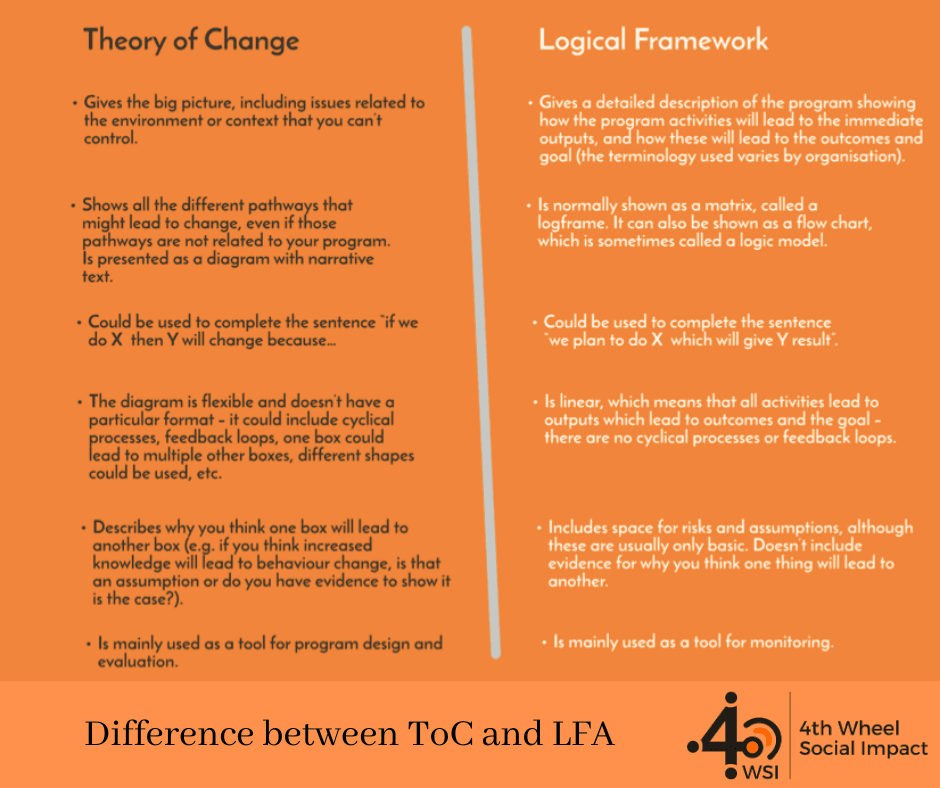
The key difference between Theory of Change and Logical Framework lies mainly in purpose and depth. A Theory of Change explains the logic behind how change is expected to happen. A LogFrame converts that logic into a structured plan for implementation, monitoring, and reporting.
Area | Theory of Change | Logical Framework |
Primary purpose | Explains how and why change is expected to happen | Organises how the project will be managed and measured |
Main focus | Pathways, assumptions, context, and long-term change | Objectives, outputs, indicators, verification, and risks |
Level of detail | Broad and strategic | Structured and operational |
Flexibility | More adaptable as learning emerges | Usually more fixed once approved |
Best stage to use | Early strategy and program design | Implementation and monitoring |
Main audience | Strategy teams, leadership, evaluators, partners | Program managers, donors, implementation teams |
Role in evaluation | Helps explain why outcomes occurred | Helps track whether planned results were achieved |
Format | Narrative, pathway map, or visual model | Usually presented as a matrix |
When considering TOC vs LogFrame, it is vital to know that neither tool can replace the other. A Theory of Change gives the program its logic. The LogFrame gives that logic an operational structure. Used together, they can create a stronger foundation for CSR planning, implementation, and evaluation.
You May Also Read: CSR Myths vs. Reality in 2026: What Organisations Need to Understand Today
When Should You Choose Theory of Change?
A Theory of Change is most useful during the early stages of program design, particularly when organisations need to understand how different interventions are expected to create long-term change. It works well for complex CSR initiatives where several factors influence outcomes and assumptions need to be examined carefully.
A Theory of Change is the better choice when:
The project addresses complex social or environmental challenges.
Multiple stakeholders contribute to the same long-term outcome.
Teams need to understand the pathway from activities to impact.
Program assumptions need to be tested before implementation.
Learning, adaptation, and continuous improvement are important priorities.
The program has several pathways and external factors shaping change.
The organisation is designing a new Theory of Change for CSR projects.
A Theory of Change creates clarity before implementation begins. It helps organisations ask the right questions and build programs on a stronger strategic foundation.
You May Also Read: What is the Difference Between Corporate Philanthropy and Corporate Social Responsibility
When Should You Choose Logical Framework?
A Logical Framework becomes valuable once the program strategy has been established and implementation planning begins. It provides the structure needed to manage activities, assign responsibilities, monitor progress, and report results consistently.
A LogFrame is the better choice when:
Project objectives and expected outcomes have already been defined.
Teams need measurable indicators and reporting systems.
Donors require structured progress reporting.
Multiple implementation partners need a common management framework.
Timelines, responsibilities, and verification methods must be clearly documented.
The project needs a clear structure for monitoring activities, outputs, and outcomes.
The project requires regular performance reviews and accountability.
Many organisations rely on the logical framework because it converts strategy into an operational plan that can be monitored throughout the project lifecycle.
How to Integrate Theory of Change with a Logical Framework Approach in CSR Projects
The two frameworks work well together when they are used at different stages of program thinking. The Theory of Change gives teams the wider picture, including pathways, assumptions, context, and causal reasoning. The Logical Framework then turns the selected pathway into a structured plan that teams can monitor and manage.
1. Define the Long-Term Change and Program Context
Start with the social change the CSR project wants to contribute to. At this stage, teams should also consider external conditions such as policy, community behaviour, market shifts, or environmental factors that may influence outcomes. A Theory of Change gives space to capture these realities before the program is reduced into a fixed implementation structure.
2. Map Multiple Pathways to Change
A strong Theory of Change can show several routes that may contribute to the same outcome. Teams should map these pathways and examine which ones the CSR project can realistically influence. This step is especially useful for complex programs where behaviour, systems, institutions, and community participation interact over time.
3. Test the Logic Behind Each Pathway
Each connection in the pathway should answer a simple question. Why do we believe this activity or outcome will contribute to the next change? Teams should document assumptions and use available evidence wherever possible. This gives the Theory of Change greater analytical value and helps identify weak links before implementation begins.
4. Select the Pathway the Program Will Implement
Once the wider change map is clear, teams can identify the pathway that falls within the project’s scope, resources, and influence. Other pathways may still remain important context, but the chosen route becomes the basis for operational planning.
5. Convert the Selected Pathway Into a LogFrame
The chosen pathway can then be translated into a Logical Framework. Activities, outputs, outcomes, indicators, means of verification, assumptions, and risks are arranged in a structured format. The LogFrame gives implementation teams a clear reference for what needs to happen and how progress will be assessed.
6. Build Indicators and Monitoring Around the LogFrame
Assign measurable indicators to the outputs and outcomes defined in the framework. Data sources, collection frequency, responsibilities, and reporting timelines should also be specified. At this stage, the LogFrame becomes the core monitoring structure for the CSR project.
7. Keep the Theory of Change Open for Learning
The LogFrame may remain relatively linear, while the Theory of Change can capture feedback loops and new learning during implementation. If monitoring data shows that an assumption is weak or another pathway is influencing results, teams can revisit the Theory of Change and refine the program logic. The LogFrame can then be updated where operational changes are required.
Conclusion
The theory of change vs logical framework comparison becomes much clearer once their roles are separated. A Theory of Change examines the wider pathway to impact, including assumptions, context, and possible routes to change.
A LogFrame takes the selected pathway and gives teams a structured way to manage activities, outputs, indicators, risks, and progress. CSR projects can gain considerable value from using both at the right stages of planning and evaluation.
At 4th Wheel, as the leading CSR consulting firm, we support organisations in developing Theory of Change models, Logical Frameworks, indicators, monitoring systems, and evaluation structures grounded in program realities.
Our expertise helps CSR teams connect strategic intent with practical implementation and credible measurement, so every stage of the project has a clear purpose and a defined way to assess progress.
Connect with 4th Wheel to build CSR frameworks that bring clarity to your strategy, structure to implementation, and credible evidence to your impact.