Capacity Building Examples for Organizations

Updated: 2 hours ago

Why do capable teams sometimes struggle to deliver consistent results?
The crux of this problem often lies in outdated processes, unclear responsibilities, or limited organizational support rather than a lack of commitment. Even experienced professionals need the right systems and skills to perform effectively.
Capacity building helps organizations address these gaps through training, mentoring, stronger management practices, and better operational systems. For NGOs, nonprofits, and development organizations, it plays an important role in improving program delivery and long-term sustainability.
The practical capacity building examples in this blog will help organizations identify suitable approaches, prioritize development needs, and invest in improvements that make a measurable difference.
Key Takeaways
Capacity building helps organizations strengthen skills, systems, and overall performance.
Real capacity building examples demonstrate the value of practical, targeted training.
Effective programs begin with clear needs assessments and development goals.
Lasting results come from applying new skills and improving everyday practices.
Table of Contents
Why Capacity Building Matters for Organizations
Capacity building lies in helping organizations overcome operational challenges, strengthen internal capabilities, and deliver programs more effectively. For NGOs and nonprofits, where resources are often limited and stakeholder expectations are high, investing in staff development and stronger organizational systems can directly improve program quality and long-term sustainability.
Key benefits include:
Improved program delivery: Stronger skills and processes help teams manage activities, resources, and implementation challenges.
Greater accountability: Clear reporting practices, financial controls, and governance systems support transparency and responsible management.
Better decision-making: Reliable data and performance reviews help organizations identify gaps and make informed improvements.
Stronger staff capabilities: Training and mentoring build technical expertise, leadership skills, and confidence in everyday responsibilities.
Organizational resilience: Documented processes and shared knowledge reduce dependence on individual employees and support continuity.
Long-term sustainability: Stronger internal systems and leadership capabilities help organizations maintain program quality across funding cycles.
Want to see how capacity development outcomes can be measured?
Read our HDFC Bank Focused Development Project case study to see how we assessed vocational training outcomes, employment experiences, and the social value generated through a structured skill development program.
Examples of Capacity Building Activities for Organizations

Effective capacity building examples demonstrate how targeted training can help organizations strengthen their technical skills, improve program management, and make better use of evidence. Our collaborations with CSRBox, Social Value UK, and GiveIndia Foundation show how different learning approaches can address specific capacity development needs.
1. CSRBox: Social Impact Measurement and Management Training
In collaboration with CSRBox, we conducted a virtual masterclass on Social Impact Measurement and Management for professionals working in the social sector. Four batches, averaging 75 participants each, attended four-day programs designed to strengthen their ability to plan, monitor, and evaluate social initiatives.
The sessions covered results-based management, Theory of Change, evaluation design, sampling, indicator development, and participatory research methods. We combined case studies with practical exercises, breakout discussions, and interactive activities to help participants apply these concepts.
Key outcome: Participants developed a stronger understanding of impact measurement frameworks and practical approaches to evaluating program performance and informing corrective action.
2. Social Value UK: Social Return on Investment Training
We collaborated with Social Value International to conduct an interactive webinar on Social Return on Investment (SROI), focusing on how organizations can assess and communicate the social value generated through their programs.
Using case studies from Indian development initiatives, we explained stakeholder identification, outcome mapping, evidence collection, impact estimation, and SROI calculations. Participants also examined principles such as transparency, stakeholder involvement, and avoiding overclaiming.
Key outcome: Participants gained a foundational understanding of SROI and received practical resources and templates to support future application within their organizations.
3. GiveIndia Foundation: Social Impact Management and Measurement Training
For GiveIndia Foundation, we delivered a four-day virtual training program focused on strengthening participants' capabilities in monitoring, evaluation, and social impact management. Each day included two hours of interactive learning through case studies, discussions, reflection exercises, and practical assignments.
The training covered results-based mansssagement, evaluation designs, sampling, research tools, indicator development, and Theory of Change. Participants also worked on developing the initial structure of a Monitoring, Evaluation, and Learning framework relevant to their programs.
Key outcome: Participants strengthened their understanding of monitoring and evaluation processes and developed a preliminary framework they could build upon to improve program monitoring, reporting, and evaluation.
Capacity Building vs Capacity Planning

The distinction between Capacity building and capacity planning matters for organizations developing their teams and operational systems.
Capacity planning identifies the people, resources, skills, and infrastructure an organization needs to meet its objectives. Capacity building focuses on developing or strengthening those capabilities.
For example, an NGO expanding its education program may use capacity planning to determine how many field coordinators and trainers it needs. Capacity building would then involve training those employees, developing supervision processes, and strengthening reporting systems.
Aspect | Capacity Building | Capacity Planning |
Purpose | Strengthen organizational capabilities | Identify required capabilities and resources |
Focus | Skills, systems, leadership, and processes | Staffing, workload, resources, and future needs |
Activities | Training, mentoring, process improvement | Resource forecasting, gap analysis, workforce planning |
Outcome | Improved organizational performance | A plan to meet operational requirements |
Approach | Ongoing development | Periodic or future-focused assessment |
Both processes complement each other. Planning helps organizations understand what is needed, while capacity building develops the skills and systems required to meet those needs.
Components of Capacity Building Activities
Effective capacity building for nonprofits and NGOs involves identifying organizational gaps, developing relevant skills, and strengthening systems that support everyday operations. While activities vary according to organizational needs, the following components form the foundation of a structured capacity-building program.
Organizational capacity assessment: Evaluating existing skills, leadership practices, internal systems, and operational challenges to identify priority development needs.
Clear development objectives: Defining specific improvements in staff capabilities, organizational processes, and program performance to guide capacity-building activities.
Training and skill development: Conducting workshops, practical exercises, and role-specific learning sessions to strengthen technical and managerial capabilities.
Mentoring and technical support: Providing ongoing guidance, coaching, and feedback to help teams apply new knowledge and address implementation challenges.
Systems and process improvement: Strengthening reporting procedures, management tools, internal communication, and operational systems to support consistent performance.
Monitoring and learning: Tracking changes in staff capabilities and organizational practices to assess progress and identify areas requiring further support.
How to Plan a Capacity Building Program
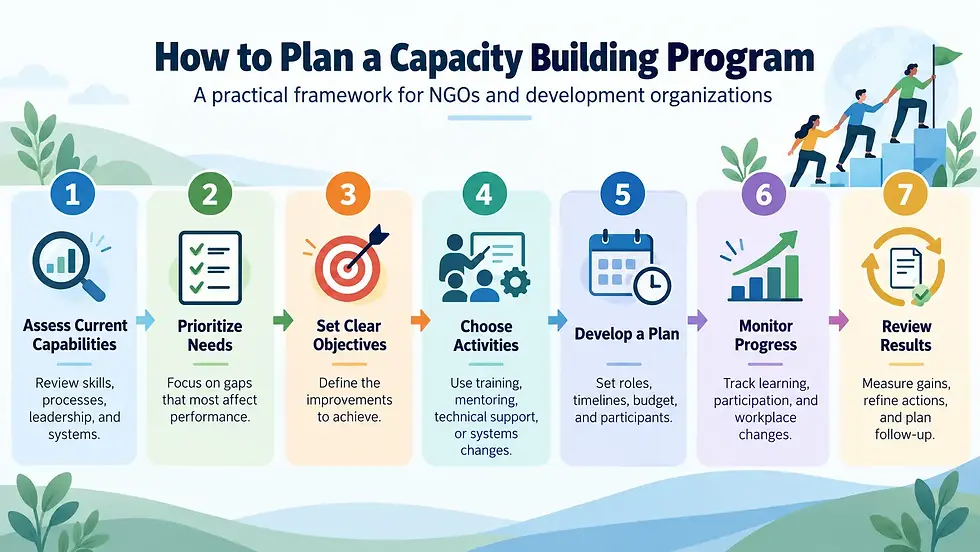
A useful capacity-building program begins with a clear organizational need. For capacity building for NGOs and other development organizations, the process should account for available resources, staff responsibilities, and the realities of field implementation.
The following steps provide a practical structure.
Step 1: Assess Current Capabilities
Review staff skills, organizational processes, leadership practices, and operational systems. Consult employees and managers to identify recurring challenges and areas where additional support is needed.
Step 2: Prioritize Development Needs
Rank capacity gaps according to their effect on organizational performance and program outcomes. Focus first on issues that create significant operational difficulties or prevent teams from meeting important objectives.
Step 3: Set Clear Objectives
Define the improvements the program should achieve. Objectives may include stronger data collection practices, improved financial controls, better supervision, or more consistent project reporting.
Step 4: Choose Suitable Activities
Select training, mentoring, technical assistance, or systems development based on the identified needs. A combination of activities may be necessary when performance gaps involve both staff skills and organizational processes.
Step 5: Develop an Implementation Plan
Identify participants, facilitators, timelines, budgets, and responsibilities. Account for staff workloads and provide sufficient time for participants to practice and apply new skills.
Step 6: Monitor Progress
Track participation, learning, and changes in work practices when you monitor impact. Regular feedback from staff and supervisors can highlight implementation difficulties and areas requiring additional support.
Step 7: Review Results and Plan Follow-Up
Assess improvements in organizational capabilities and performance. Use the findings to identify remaining gaps, refine activities, and determine future capacity-building priorities.
Choose 4th Wheel for Capacity Building Services
Effective capacity building for nonprofits and development organizations depends on understanding their operational challenges and designing support around practical needs. At 4th Wheel, we work with NGOs, CSR teams, foundations, and other development organizations to strengthen the skills, systems, and processes that support program effectiveness.
Our capacity-building services draw on experience in impact strategy, research, monitoring and evaluation, and organizational development. We help teams connect technical knowledge with everyday implementation requirements.
Our support includes:
Organizational capacity assessments: Identifying gaps in staff capabilities, processes, monitoring systems, and organizational practices.
Monitoring and evaluation training: Building skills in indicator development, data collection, data quality, analysis, and reporting.
MEAL framework development: Supporting practical systems for monitoring, evaluation, accountability, and learning.
Theory of Change development: Helping teams clarify program objectives, intended outcomes, and measurement approaches.
Research and data management training: Strengthening capabilities in research methods, field data collection, and interpretation of findings.
Technical guidance: Supporting teams as they apply new tools, processes, and learning in their programs.
We turn organizational needs into practical learning and lasting improvements in skills, systems, and performance.
Conclusion
The capacity building examples covered in this guide highlight how different organizational challenges call for different forms of support. From strengthening monitoring practices to developing technical skills and improving internal systems, effective capacity building starts with identifying the gaps that affect performance.
What matters most is how well these efforts translate into stronger teams, more reliable processes, and better program outcomes.
4th Wheel supports NGOs, nonprofits, CSR teams, and development organizations through capacity assessments, training, MEAL frameworks, and technical guidance. Our work connects organizational development with practical program requirements, helping teams strengthen their monitoring capabilities, improve internal processes, and use evidence more effectively.
Looking to strengthen your organization's capabilities? Contact 4th Wheel to design a capacity-building program that addresses your team's priorities and operational needs.